[talk about picking
and choosing]
When we hear about mixing, a lot of attention
is devoted to balancing and equalizing. To
understand why these two things are important, we should consider how mixing
works, and how sounds come together in general.
When our brain perceives a sound wave in real life, it is usually not as
pure when heard as it is when produced by its source. In-between, it goes through transformations
due to physical travel of the acoustic energy; it is superimposed and distorted
by in-between sounds coming from other sources.
When we listen to a mixed song, we are hearing two tracks (most
commonly) – one for the left ear, one for the right, a.k.a. stereo. Both of these tracks contain similar sonic
information, incorporating multiple instruments, voices, noises, pulses, and
other parts of a mix. How does all this
seemingly different sonic information come together into only a pair of tracks?
Think of
the most basic property of sound: the overtone series. When a note is played, we hear most
prominently the fundamental frequency (which is that of the note played), and
the overtones, which are multiples (or fractions, depending on how you look at
it) of that fundamental frequency. Each
represents certain characteristics of the Lydian scale; depending on which
characteristics those are and how prominent (loud) they are relative to each
other, the overall tone may be perceived as one instrument or another (or even as
multiple instruments).
When we are
mixing, a similar thing occurs, except that instead of pure harmonics, complex
wave forms are superimposed. So let’s
begin by looking at the superimposition of overtones, and hopefully we’ll get
some insight into how waves interact when they are mixed.
Thus, let’s
talk about some overtone basics, so that we can better judge what effect
various mixing techniques will have.
First, we will examine a close series of overtones. Be forewarned, these are guitar-produced waves,
so not all shapes are perfect (also disregard the relative phase). These samples are normalized to demonstrate
the shapes; in reality, the amplitude of each unique overtone.

Notice how
each succeeding overtone, being at a higher frequency than the previous one,
alters the minute detail of the fundamental shape. The smaller the overtone with respect to the
fundamental, the more minute the detail will be. We’ll take a look at what role that plays in
a minute; for now, let’s look at a selection of four fundamental overtones
(from above taking fundamental, fifth, second octave,
and major 3rd):

Again,
these are normalized to enable easiest comparison in shape. However, to simulate a real overtone series,
we’ll reduce the volume of each shape: 5th will be reduced -6db,
octave -12db, and major 3rd -15db.
Every instrument produces various harmonic overtones, and as we
discussed in the Recording article, the stages between acoustic energy produced
by an instrument and digital data recorded to represent that energy will color
the tone by boosting or reducing the various overtones that the instrument
produces. This is exactly what makes
different instruments (such as guitars and trumpets) sound distinct from each
other; it is also the property that causes differentiation between various pickups,
microphones, amps, and speakers. However, our aforementioned approximation will
do for this illustration:

So let’s
assume that each of the above four waves is a representation on a graph (which
it is –a decibel graph), and that the zero crossing is a Y=0 position. Now, we’ll add the four “functions”,
altogether as well as in selective combinations. Below are the three representations in
successive superimposition:

Here is
another diagram, of the previous two at scale with each other. We can notice how after each additional overtone
the final shape of the wave becomes molded.

The shape
generated in pale red above is, for our current purpose, a representation of
what some physical instrument might “sound” like. The shape of the wave causes us to
differentiate that particular instrument from any other one the waveform of
whose sound is different enough. The
shapes for many acoustic instruments (especially grand piano or acoustic guitar
are very smooth (like the one we have above); however, other instruments, such
as overdriven electric guitar – not so much.
Let’s consider why this happens.
Suppose we took a pure guitar tone, and ran it through an amp that
boosted the hell out of a particular group of relatively high overtones into
infinity (clarification for modeler users: Mid-Freq=2500Hz; Mid-Gain=+9;
Amp-Gain=80). Next, a relatively low
note is played (e.g. A=220); it determines the overall shape of the sound, as
did the fundamental in our previous example.
The super-boosted high-frequency overtones (for the A in question,
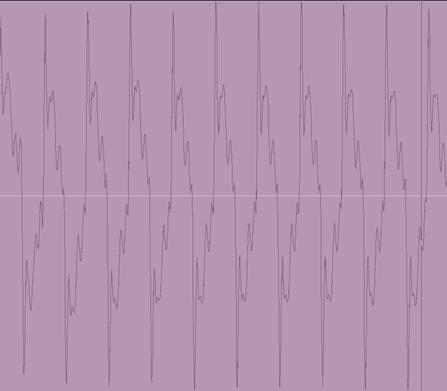
overtone octaves 10-12 – we’re talking dog whistle here) are superimposed. Our end result is a jagged sound wave, that we perceive as noise or distortion.
Here’s a
zoom of an overdriven harmonic, drastically normalized to examine the shape
closer:
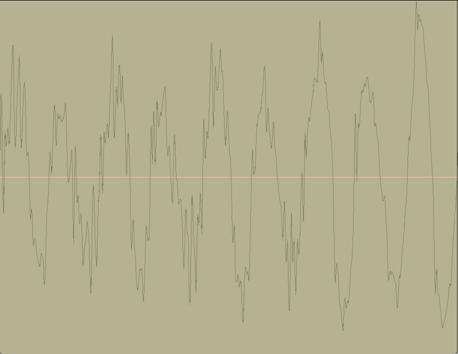
Here’s a
zoom on a sound wave of a single-note lead guitar sound (including all
overtones – this is the only one here that’s an actual guitar sound). You may be thinking, “Wow that’s cool! So that’s what I want all my waves to look
like!” Well, not really. When, we’re superimposing waves in a mix
(usually dozens of different sound sources), and more than a few of those
sources have similar-frequency harmonics, those edges you see on the last
diagram become noise rather than [good-sounding] distortion, and end up ruining
the mix.
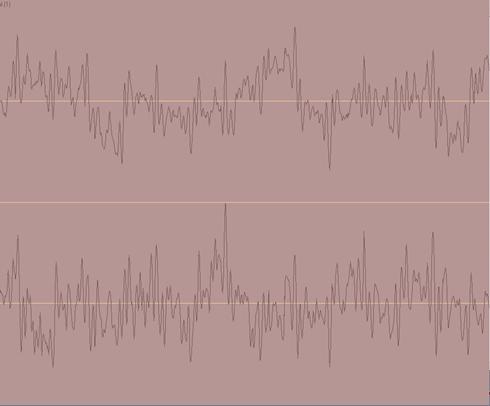
Finally,
here’s what a wave shape of an entire mix looks like. It includes all the instruments, drums,
voice, reverbs and other effects – all the fundamentals and overtones of all
those things are superimposed. Notice
there’s considerable difference between Left and Right stereo channels:
Hopefully
during recording, the sounds we captured do not overlap too much in frequency
range; in mixing, we will take care to do several other things. We know that the loudest parts of the mix
will have the biggest effect on the overall shape; therefore, all the loudest
objects should be enumerated by the frequencies they affect predominantly. The softer parts will dictate what details
are most heard – this is where we get qualities such as “presence” or “annoying
buzz” into our mix. There are three
points to keep in mind here:
- Determine which frequency range
of each instrument makes it sound best; boost that frequency slightly and
lower it in all other instruments in the mix position.
- Balance the levels of recorded
parts in different ranges (e.g., bass and rhythm guitar) so that their
superimposition does not cause them to clash, drown each other out, and
bring mud to the mix
- Ensure that the peaks of
tracks’ overall amplitude ranges are not too drastic; lower those that
stick out.
Eat that, bizzatch!